
Introduction
If you are planning to build web applications, APIs, cloud services, or enterprise software, you will frequently hear one name: .NET.
.NET is a free, open-source, cross-platform development platform created by Microsoft. It allows developers to build applications that run on Windows, Linux, macOS, and even mobile and cloud environments.
In this article, you will learn:
- What .NET really is
- How .NET evolved over time
- Why developers choose .NET in 2025
- What types of applications you can build with it
This is Week 1 of our weekly .NET blog series. By the end of this series, you’ll be able to build and deploy production-ready .NET applications.
What Is .NET?
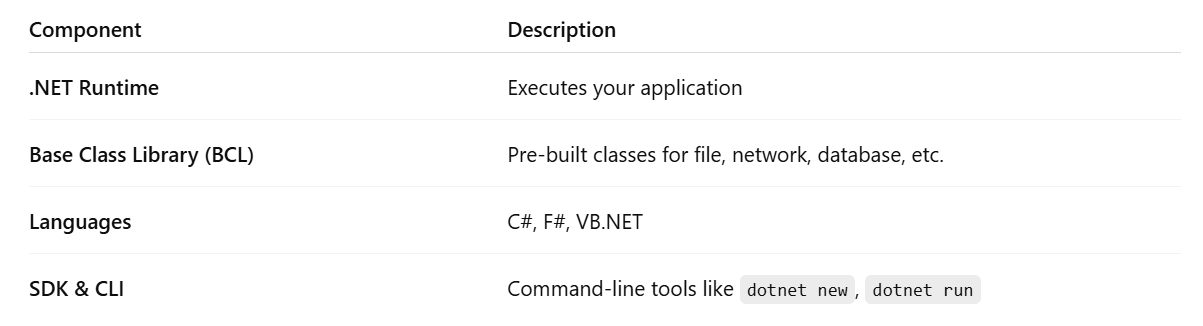
.NET is a developer platform that provides:
- A runtime to execute applications
- Libraries for common tasks
- Languages like C#, F#, and VB.NET
- Tools for building, testing, and deploying software
At its core, .NET helps developers write code once and run it anywhere.
Key Components of .NET
Evolution of .NET (Short History)
Understanding the evolution of .NET helps clear confusion many beginners have.
1️⃣ .NET Framework (2002)
- Windows-only
- Used mainly for desktop and enterprise apps
- No longer actively developed
2️⃣ .NET Core (2016)
- Cross-platform
- High performance
- Open source
- Designed for modern web & cloud apps
3️⃣ Unified .NET (2020 → Present)
Microsoft merged everything into one platform.
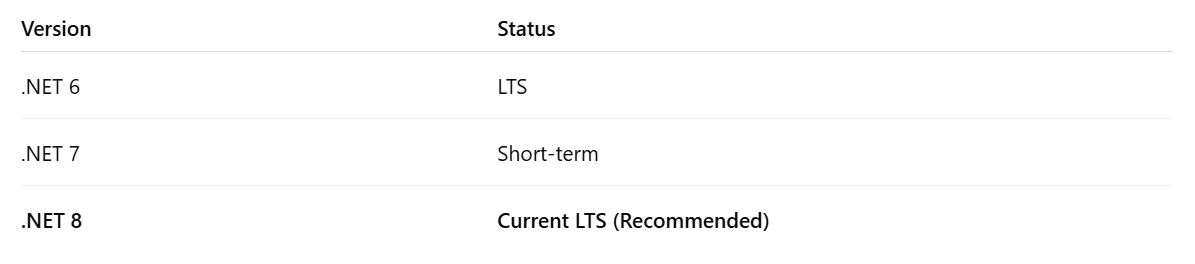
👉 In 2025, always use .NET 8 (or latest LTS)
Why Choose .NET in 2025?
.NET is no longer just a “Microsoft thing.” It’s one of the most powerful platforms today.
✅ Key Advantages
- ⚡ High performance (faster than many alternatives)
- 🌍 Cross-platform
- 🔐 Enterprise-grade security
- ☁️ Cloud-native (Azure, AWS, GCP)
- 🧩 Massive ecosystem & libraries
- 🧑💻 Strong community support
Companies Using .NET
- Microsoft
- Stack Overflow
- Alibaba
- Samsung
- Dell
What Can You Build with .NET?
.NET is extremely versatile.
🖥 Web Applications
- ASP.NET Core MVC
- Razor Pages
- Blazor
🌐 REST APIs
- ASP.NET Core Web API
- Microservices
- Backend for mobile apps
📱 Mobile Apps
- .NET MAUI (Android & iOS)
☁ Cloud & Microservices
- Docker
- Kubernetes
- Azure Functions
🖥 Desktop Applications
- WPF
- WinForms
Popular .NET Languages
🔵 C# (Most Popular)
- Modern
- Strongly typed
- Object-oriented
- Used in most .NET projects
🟣 F#
- Functional programming
- Data-driven applications
🟡 VB.NET
- Legacy support
- Not recommended for new projects
👉 C# is the best choice for beginners
Tools You’ll Use as a .NET Developer
- Visual Studio (Full IDE)
- Visual Studio Code (Lightweight)
- .NET CLI
- Git & GitHub
- Docker (later)
Example command:
dotnet new webapi
dotnet run
Common Myths About .NET
❌ “.NET is Windows only”
✅ False – It’s fully cross-platform
❌ “.NET is slow”
✅ False – One of the fastest backend platforms
❌ “.NET is dying”
✅ False – Actively developed & widely adopted
What You’ll Learn in This Blog Series
Over the next weeks, you’ll learn:
- ASP.NET Core fundamentals
- Web API development
- Database with EF Core
- Authentication (JWT)
- Clean Architecture
- Performance optimization
- Testing & Deployment
Conclusion
.NET is a modern, powerful, and future-proof platform for building almost any type of application. Whether you are a beginner or an experienced developer, learning .NET in 2025 is a smart career decision.