
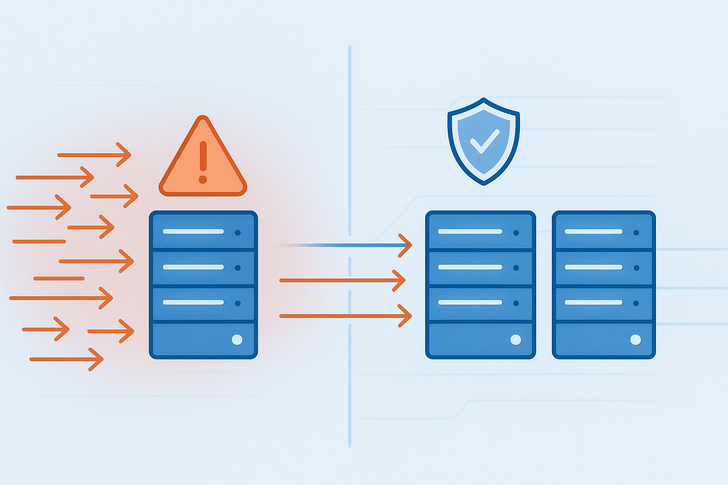
What School Doesn't Teach You About Scaling and Protection
When learning about distributed systems and web architecture, you'll encounter plenty of theoretical concepts. But there's a crucial practical distinction that often gets overlooked until you're managing production systems: Load balancers and rate limiters serve fundamentally different purposes, and you absolutely need both.
The Load Balancer: Traffic Distributor Extraordinaire
What It Does
A load balancer acts as a traffic cop for your web servers, distributing incoming client requests across multiple backend servers. It's primarily concerned with where traffic goes, not how much traffic arrives.
Common Load Balancing Strategies:
- Round Robin: Distributes requests sequentially
- Least Connections: Sends traffic to the server with fewest active connections
- IP Hash: Consistently routes same client to same server
- Weighted Distribution: Accounts for server capacity differences
Example: E-Commerce Platform
┌─────────────┐
│   Clients   │
│  (1000/day) │
└──────┬──────┘
       │
┌──────▼──────┐
│ Load Balancer│
└──────┬──────┘
       │
   ┌───┼───┐
   │   │   │
┌──▼─┐┌─▼──┐┌─▼──┐
│Web ││Web  ││Web │
│Svr 1││Svr 2││Svr 3│
└─────┘└─────┘└─────┘
Problem Solved: The load balancer ensures no single server gets overwhelmed by evenly distributing 1,000 daily requests across three servers (~333 requests each).
Problem NOT Solved: What happens when a bot starts hitting your site with 10,000 requests per second?
The Fatal Flaw: Load Balancers Don't Prevent Overload
The Misconception
Many engineers assume: "If I have a load balancer with auto-scaling, I'm protected from traffic spikes."
The Reality
Scenario: DDoS Attack or Buggy Client

1. Malicious bot sends 10,000 requests/second
2. Load balancer dutifully distributes them:
   - Server 1: ~3,333 requests/second
   - Server 2: ~3,333 requests/second
   - Server 3: ~3,334 requests/second

3. Each server's resources are saturated
4. Database connections exhausted
5. Memory consumption skyrockets
6. All servers crash simultaneously
The load balancer successfully distributed the traffic—it just distributed catastrophic failure evenly across your infrastructure.
Rate Limiting: Your Traffic Enforcer
What It Does
Rate limiting controls how many requests a client can make within a specific time window. It's fundamentally about protection, not distribution.
Common Rate Limiting Algorithms:
- Token Bucket: Allows bursts up to a maximum
- Leaky Bucket: Smooths out request rates
- Fixed Window: Simple counting per time window
- Sliding Window: More accurate time-based limiting
Example Implementation (Pseudocode):
class RateLimiter:
    def __init__(self, requests_per_minute):
        self.requests_per_minute = requests_per_minute
        self.requests = {}  # client_id -> [timestamps]

    def is_allowed(self, client_id):
        now = time.time()
        if client_id not in self.requests:
            self.requests[client_id] = []

        # Remove old requests (older than 1 minute)
        self.requests[client_id] = [
            ts for ts in self.requests[client_id]
            if now - ts < 60
        ]

        if len(self.requests[client_id]) < self.requests_per_minute:
            self.requests[client_id].append(now)
            return True
        return False  # Rate limit exceeded
Real-World Scenario: API Protection
Without Rate Limiting:
┌─────────────┐     ┌─────────────┐     ┌─────────────┐
│   API       │     │   Load      │     │   Backend   │
│   Gateway   ├────►│   Balancer  ├────►│   Servers   │
└─────────────┘     └─────────────┘     └─────────────┘

User A: 10,000 req/sec  ────────────────────────────────►
                                                        │
Result: All servers crash, database locks up,         ▼
        paying customers can't access service         💥
With Rate Limiting:
┌─────────────┐     ┌─────────────┐     ┌─────────────┐
│   API       │     │   Load      │     │   Backend   │
│   Gateway   ├────►│   Balancer  ├────►│   Servers   │
│ + Rate      │     │             │     │             │
│   Limiting  │     │             │     │             │
└─────────────┘     └─────────────┘     └─────────────┘
        │
User A: 10,000 req/sec                             │
        │                                          │
        ▼                                          ▼
"429 Too Many Requests" for requests              ✅
beyond 100 req/minute limit                       Stable system
Why You Need Both: A Layered Defense Strategy
1. Edge Layer (CDN/API Gateway)
- Rate limiting per IP/API key
- Geo-blocking malicious regions
- DDoS protection
2. Load Balancer Layer
- Health checks to remove failing servers
- SSL termination
- Session persistence
3. Application Layer
- Business logic rate limiting
- User-tier based limits (free vs. paid)
- Expensive operation throttling
4. Database/Service Layer
- Connection pooling limits
- Query rate limiting
- Queue-based request buffering
Practical Implementation Example
Architecture:
┌─────────────────────────────────────────────────┐
│                Cloudflare/WAF                   │
│          (Global rate limiting)                 │
└────────────────────────┬────────────────────────┘
                         │
┌────────────────────────▼────────────────────────┐
│                API Gateway                       │
│        (Per-client rate limiting)               │
└────────────────────────┬────────────────────────┘
                         │
┌────────────────────────▼────────────────────────┐
│              Load Balancer                      │
│     (Traffic distribution + health checks)      │
└────────────────────────┬────────────────────────┘
                         │
         ┌───────────────┼───────────────┐
         ▼               ▼               ▼
┌──────────────┐ ┌──────────────┐ ┌──────────────┐
│   Service A  │ │   Service B  │ │   Service C  │
│  (with app-  │ │  (with app-  │ │  (with app-  │
│   level RL)  │ │   level RL)  │ │   level RL)  │
└──────────────┘ └──────────────┘ └──────────────┘
Configuration Example (NGINX + Rate Limiting):
# Load balancing configuration
upstream backend {
    least_conn;
    server backend1.example.com;
    server backend2.example.com;
    server backend3.example.com;
}

# Rate limiting configuration
limit_req_zone $binary_remote_addr zone=mylimit:10m rate=10r/s;

server {
    location /api/ {
        # Apply rate limiting
        limit_req zone=mylimit burst=20 nodelay;

        # Pass to load balancer
        proxy_pass http://backend;

        # Additional protection
        limit_req_status 429;  # Custom HTTP status
    }
}
Common Pitfalls and Solutions
1. The "Magic Bullet" Fallacy
❌ Wrong: "Our cloud provider's load balancer has protection features"
✅ Right: Implement defense in depth with multiple rate limiting layers
2. Ignoring Business Logic Attacks
Example: A user rapidly checks inventory to snipe products
Solution: Implement endpoint-specific limits beyond global IP limits
3. Forgetting About Distributed Systems
Single-server rate limiting fails in clustered environments
Solution: Use Redis or similar for distributed rate limiting
4. Static Limits in Dynamic Environments
Solution: Implement adaptive rate limiting based on system health
Advanced Considerations
1. User-Tier Based Limits
def get_rate_limit(user_tier):
    limits = {
        'free': {'requests': 100, 'window': 'hour'},
        'pro': {'requests': 1000, 'window': 'hour'},
        'enterprise': {'requests': 10000, 'window': 'hour'}
    }
    return limits.get(user_tier, limits['free'])
2. Cost-Based Rate Limiting
Some API endpoints are more expensive (database-intensive, third-party calls). Implement different limits:
- Search endpoint: 100 req/minute
- Report generation: 5 req/minute
- User profile: 1000 req/minute
3. Graceful Degradation
Instead of just blocking:
- Return cached data
- Queue requests for later processing
- Provide estimated wait times
Monitoring and Metrics
Essential metrics to track:
- Rate limit hits: How often are limits being reached?
- Client distribution: Which clients hit limits most?
- Endpoint analysis: Which endpoints need adjustment?
- False positives: Legitimate users being blocked?
Conclusion: The Unbreakable Partnership
Load balancing and rate limiting are complementary technologies that solve different problems:
Aspect				Load Balancer			Rate Limiter
Primary Goal		Distribute load			Control flow
Protection Level	None					High
Focus				Server availability		Service protection
What It Controls	Where requests go		How many requests
Failure Scenario	Distributes overload	Prevents overload
The Bottom Line:
- Use load balancers to scale horizontally and ensure high availability
- Use rate limiting to protect your infrastructure from abuse and overload
- Combine both for resilient, scalable, and protected applications
The modern web stack requires both traffic distribution and traffic control. One without the other is like having a highway system (load balancer) without speed limits or traffic lights (rate limiting)—eventually, you'll have a catastrophic pileup.
Implement both, monitor their interaction, and adjust as your application grows. Your users—and your sanity—will thank you.