
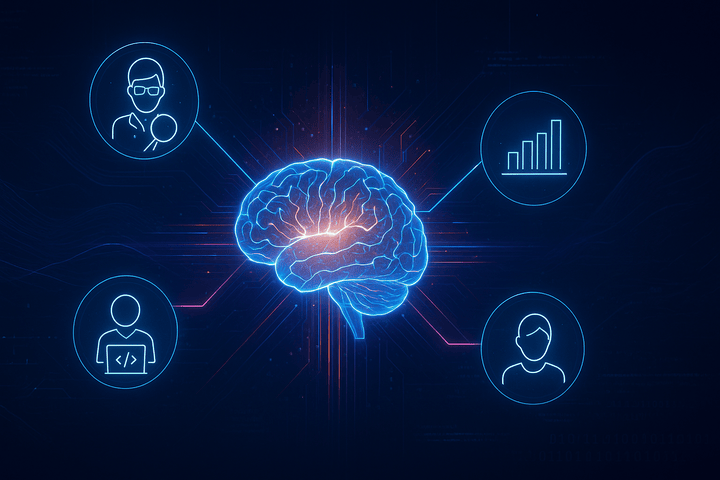
The Model Context Protocol (MCP) is rapidly evolving from a simple tool-connector into a framework for building sophisticated, autonomous AI agents. This new paradigm moves beyond single agents performing isolated tasks, focusing instead on creating teams of collaborative agents that reason, share context, and leverage the world's most powerful models. Here’s a breakdown of how to build these advanced MCP agents.
The Core Shift: From Single Tools to Collaborative Agents
Traditional MCP setups let an LLM like ChatGPT access a database or an API. Advanced MCP reimagines these "tools" as full-fledged, independent agents. Each agent has a specialized role—a Researcher Agent, a Coder Agent, an Analyst Agent—and its own set of tools and context.
The magic happens not in a single agent, but in their collaboration.
1. Multi-Agent Coordination: The Power of Teamwork
The key to complexity is breaking a problem down. Advanced MCP uses a orchestrator or controller agent (often the main LLM, like Claude or GPT) to manage a team of specialized MCP agent-servers.
- How it Works: The orchestrator receives a high-level user prompt (e.g., "Analyze Q2 sales data and write a blog post about our top-performing product").
- Task Decomposition: It decomposes this into sub-tasks: fetch data, analyze trends, generate insights, write a draft.
- Agent Delegation: The orchestrator delegates each task to the best-suited agent via MCP, passing along the necessary context.
- Result Synthesis: The orchestrator collects the results from each specialist agent and synthesizes them into a final, cohesive output for the user.
This approach is far more powerful, reliable, and efficient than a single model trying to do everything at once.
2. Dynamic Context Awareness: The Right Information at the Right Time
Basic MCP provides static tools. Advanced MCP agents are context-aware. They don't just retrieve data; they understand the specific task at hand and dynamically gather relevant information.
- Retrieval-Augmented Generation (RAG): An agent can query a vector database to find the most relevant documents, code snippets, or past decisions related to the current query before acting.
- Real-Time Awareness: Agents can connect to live data sources (APIs, news feeds, database streams) to ensure their actions are based on the most current information possible, not just static knowledge.
This turns agents from simple executors into informed partners that operate with a deep understanding of their environment.
3. Gemini Integration: Leveraging Multi-Modal Strength
A significant advantage of MCP is its model-agnostic nature. You are not locked into one LLM. A powerful pattern is using Claude for reasoning and orchestration while seamlessly integrating Google's Gemini for specific multi-modal tasks.
- Leveraging Strengths: Claude is renowned for its deep reasoning and instruction-following, making it an ideal orchestrator. Gemini 2.0 Flash is incredibly fast and cost-effective for multi-modal processing.
- Practical Workflow: The orchestrator (Claude) identifies a need for image analysis within a task. It uses an MCP tool to send the image to a Gemini-integrated agent. Gemini analyzes the image, returns a description or extracted text, and Claude uses that context to continue its reasoning flow. This creates a best-of-both-worlds system.
A Practical Example: The Multi-Agent Workflow
Imagine a user asks: "Based on the latest tech news, draft a tweet thread about NVIDIA's stock performance and generate a relevant chart."
- Orchestrator Agent (Claude) decomposes the query.
- Delegation: It calls:
- A News Agent via MCP to fetch the latest articles about NVIDIA.
- A Financial Data Agent to get the latest stock price data.
- Synthesis & New Task: Claude reads the results and drafts the tweet thread. It identifies the need for a chart.
- Multi-Modal Delegation: Claude calls a Data Visualization Agent with the stock data. This agent, integrated with a Python tool, generates a chart image.
- Final Output: Claude presents the user with the complete package: the drafted tweet thread and the generated chart.
How to Get Started Building
- Choose Your Framework: Start with the MCP SDK for Node.js or Python. Tools like Claude CLI and Sylvain are invaluable for testing and debugging your MCP servers.
- Design Agent Roles: Define the specialized agents you need (Researcher, Coder, Analyst, etc.).
- Develop MCP Servers: Build each agent as its own MCP server, exposing its specific set of tools (e.g.,
search_web,query_database,generate_chart). - Implement Orchestration: Develop the prompt engineering logic for your main LLM to act as an effective orchestrator, teaching it how and when to call each agent.
- Integrate Models: Connect external APIs, like the Gemini API, to your specialized agents to augment their capabilities.
Conclusion
The future of MCP lies in building ecosystems of collaborative agents. By combining multi-agent coordination, dynamic context awareness, and the strategic integration of powerful models like Gemini, developers can create AI systems that are more capable, reliable, and intelligent than any single model or tool could be alone. This moves us from simple AI assistants toward true AI collaborators.