
Introduction
In the ever-evolving landscape of programming languages, Google has introduced Mangle - a specialized language designed for one specific but crucial task: reasoning over massive knowledge graphs. While most developers work with general-purpose languages, Mangle represents a fascinating shift toward domain-specific solutions for complex AI challenges.
What is Mangle?
Mangle is a domain-specific language (DSL) based on Datalog, specifically created for declarative reasoning over large-scale knowledge graphs. It's not intended to replace languages like Python or Java, but rather to excel where they struggle: efficiently deducing new insights from billions of interconnected facts.
Key Characteristics:
- Declarative Syntax: Describe what you want, not how to compute it
- Logic Programming Foundation: Built on formal logic principles
- Scalability First: Designed for planet-scale knowledge graphs
- Google-Knowledge-Graph Native: Optimized for Google's infrastructure
The Problem Mangle Solves
Knowledge Graphs at Scale
Google's knowledge graph contains billions of entities and trillions of relationships. Traditional approaches to reasoning over this data face significant challenges:
# Traditional imperative approach (simplified)
def find_european_capitals():
    results = []
    for country in countries:
        if country.continent == 'Europe':
            capital = get_capital(country)
            results.append(capital)
    return results
This imperative style becomes inefficient and unmaintainable at Google's scale. Mangle provides a declarative alternative.
Mangle by Example
Basic Syntax and Rules
prolog
% Define facts from knowledge graph
isCapitalOf("Paris", "France").
isCapitalOf("Berlin", "Germany").
isLocatedIn("France", "Europe").
isLocatedIn("Germany", "Europe").

% Define reasoning rule
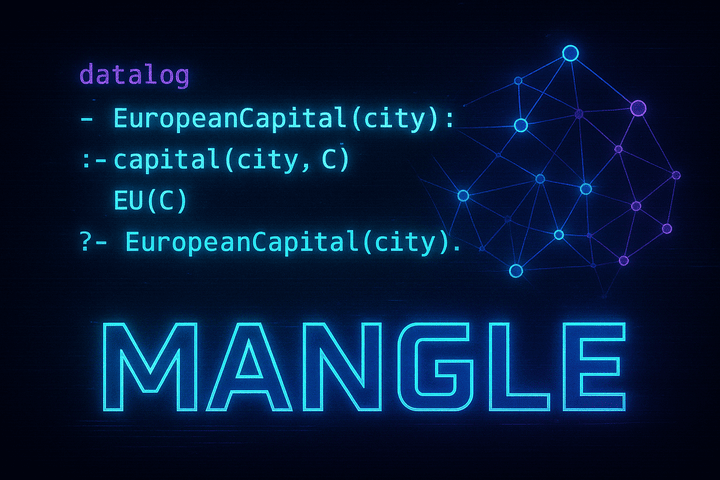
EuropeanCapital(City) :-
    isCapitalOf(City, Country),
    isLocatedIn(Country, "Europe").

% Query execution
? EuropeanCapital(X).
% Returns: X = "Paris", X = "Berlin"
More Complex Reasoning
% Multi-hop reasoning
IsConnected(Start, End) :-
    directlyConnected(Start, End).

IsConnected(Start, End) :-
    directlyConnected(Start, Intermediate),
    IsConnected(Intermediate, End).

% Temporal reasoning
CurrentlyValid(Fact) :-
    validFrom(Fact, StartTime),
    validUntil(Fact, EndTime),
    currentTime(Now),
    StartTime =< Now,
    (EndTime = null ; Now =< EndTime).
Technical Architecture
How Mangle Works Under the Hood
- Query Parsing: Mangle queries are parsed into abstract syntax trees
- Rule Application: Rules are applied recursively to derive new facts
- Incremental Evaluation: Only computes changes to avoid full recomputation
- Distributed Execution: Runs across Google's distributed infrastructure
Performance Features
- Incremental Updates: Efficiently handles data changes
- Parallel Execution: Leverages distributed computing
- Optimized Join Algorithms: Specialized for graph operations
- Memory Management: Handles large intermediate results efficiently
Real-World Applications
1. Enhanced Search Intelligence
% Example: Improving search contextual understanding
RelatedToTopic(Entity, Topic, Score) :-
    mentions(Entity, Topic, Frequency),
    connectedTo(Entity, Topic, PathLength),
    Score = Frequency / (PathLength + 1).
2. AI and Machine Learning
- Feature Engineering: Deriving complex features from knowledge graphs
- Model Explanation: Reasoning about AI model decisions
- Data Validation: Ensuring consistency in training data
3. Business Intelligence
% Supply chain optimization
CriticalSupplier(Supplier) :-
    supplies(Supplier, Component),
    essentialFor(Component, Product),
    singleSource(Component, Supplier).
Getting Started with Mangle
Current Status
As of now, Mangle is primarily used internally at Google. However, understanding its concepts can benefit developers working with:
- Graph databases (Neo4j, Amazon Neptune)
- Logic programming (Prolog, Datalog)
- Knowledge representation systems
- Large-scale data processing
Similar Open-Source Alternatives
- Soufflé: High-performance Datalog engine
- Datomic: Database with Datalog querying
- Cypher: Query language for graph databases
Why Mangle Matters for Developers
1. Declarative Programming Renaissance
Mangle demonstrates the power of declarative approaches for specific problem domains. As systems grow more complex, telling the computer what we want rather than how to get it becomes increasingly valuable.
2. Specialization Over Generalization
The era of one-size-fits-all languages may be evolving. Mangle shows how domain-specific languages can outperform general-purpose tools for particular tasks.
3. AI Infrastructure Evolution
As AI systems become more sophisticated, specialized tools like Mangle will be crucial for handling the complexity of knowledge representation and reasoning.
Challenges and Considerations
Learning Curve
- Requires understanding of logic programming
- Different mindset from imperative programming
- Limited community and resources compared to mainstream languages
Practical Limitations
- Not suitable for general application development
- Tightly coupled with Google's infrastructure
- Steep learning curve for traditional developers
Conclusion
Google's Mangle represents an important evolution in how we approach complex reasoning problems at scale. While most developers may never use Mangle directly, its concepts influence how we think about:
- Knowledge representation
- Declarative programming
- Large-scale reasoning systems
- Domain-specific language design
As AI continues to advance, the principles behind Mangle will likely become increasingly relevant across the industry.